
What to See Near the Pantheon: A Half-Day Itinerary
The Pantheon sits at the centre of Rome’s most walkable historic district. Within a 15-minute radius on foot are Piazza Navona (5 min), the Trevi Fountain (10 min), Campo de’ Fiori (8 min), the Temple of Hadrian (3 min), Sant’Ignazio church (3 min), and Largo di Torre Argentina (5 min). A half-day of 3–4 hours covers the Pantheon plus three or four of these stops comfortably. The route from Piazza Navona through the Pantheon to the Trevi Fountain is one of the finest 45-minute walks in Europe.
The Pantheon’s location in the historic centre makes it the natural anchor for a half-day of exploration. The streets and piazzas surrounding it contain some of the most concentrated sightseeing value in the world — multiple world-class landmarks within five to fifteen minutes of each other on foot, connected by medieval lanes, baroque piazzas, and Renaissance palaces. This guide gives you a practical, logistically sound half-day itinerary that works whether you have a morning, an afternoon, or an evening.
Before You Start: Pre-Book Your Pantheon Ticket
The single most important logistical step for this itinerary is booking your Pantheon timed entry slot before your visit day. Popular time slots — particularly between 10:00 and 14:00 in peak season — sell out two to three days in advance. Pre-booking determines when your itinerary starts, so secure your slot first, then build the rest of the day around it.
For all booking options, see our Pantheon Tickets guide. For advice on the best time of day, see Best Time to Visit the Pantheon.
The Half-Day Itinerary
Stop 1: Piazza Navona (30–45 minutes)
Walking time from Pantheon: 5 minutes Address: Piazza Navona, 00186 Roma
Begin at Piazza Navona, one of Rome’s most spectacular public spaces. The piazza’s elongated oval shape traces the footprint of the ancient Stadium of Domitian (1st century AD), which seated 30,000 spectators for athletic contests. The stadium’s outline is preserved almost perfectly in the piazza’s form — when you look at it from above, you are looking at the ghost of an ancient building.
The three fountains are the piazza’s main attraction. The centrepiece is Bernini’s Fountain of the Four Rivers (1651) — four colossal river gods representing the Nile, Danube, Ganges, and Río de la Plata, arranged around an Egyptian obelisk. The figures are among Bernini’s most celebrated sculptures, full of dynamic tension and baroque theatricality. The rival fountain at the southern end was designed by Borromini — the architectural nemesis of Bernini — adding an extra layer of drama to the piazza’s history. The church of Sant’Agnese in Agone, whose curving façade dominates the western side, is also Borromini’s work.
Café seating lines the piazza’s perimeter. Coffee in the piazza comes with a tourist surcharge, but the setting is unmatched.
Walking route to the Pantheon: Exit the piazza at its southern end and walk east along Corso del Rinascimento. At the end of the street, turn right onto Via del Salvatore, then left onto Via della Palombella. Piazza della Rotonda and the Pantheon entrance are straight ahead.
Stop 2: The Pantheon (45–60 minutes)
Address: Piazza della Rotonda, 00186 Roma Ticket: Pre-book in advance — see our Pantheon Tickets guide
The Pantheon is the centrepiece of the itinerary and the only stop that requires a pre-booked timed ticket. Allow 45–60 minutes with an audio guide, or 20–35 minutes for an independent visit.
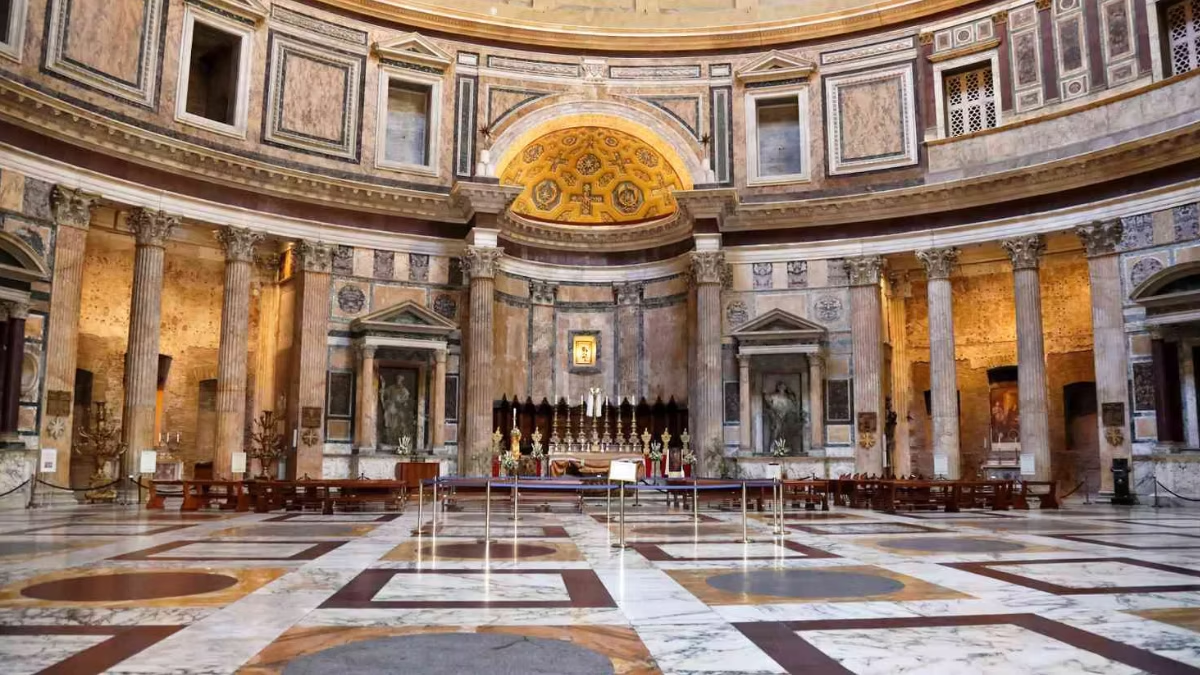
The key elements to see: the oculus and the beam of light it admits, the coffered concrete dome, the ancient marble floor, Raphael’s tomb in the third niche on the left, the royal tombs of Victor Emmanuel II and Umberto I, and the proportions of the interior — the diameter of the dome equals its height, creating a perfect sphere. For a room-by-room breakdown of everything inside, see our Inside the Pantheon guide.
Two hidden gems to notice on your way out:
Just east of the Pantheon, a two-minute walk along Via di Pietra, is the Tempio di Adriano (Temple of Hadrian) — eleven Corinthian columns from a 2nd-century temple, now incorporated into the façade of the Rome Chamber of Commerce building. Most visitors walk past without noticing. It is one of the best-preserved Roman temple fragments in the city.
Three minutes from the Pantheon, on Piazza di Sant’Ignazio, is the Church of Sant’Ignazio di Loyola — a Jesuit church with one of the most extraordinary trompe l’oeil ceiling frescoes in Rome. Andrea Pozzo’s painted ceiling creates a completely convincing illusion of a vast dome and architectural space where none exists. Stand on the marble disc in the centre of the nave for the full effect. Entry is free.
Walking route to the Trevi Fountain: With your back to the Pantheon entrance, exit Piazza della Rotonda to the right (east) along Via dei Pastini. Follow it past small shops and bars until it opens into Piazza di Pietra (the Temple of Hadrian columns are on your left). Continue east along Via di Pietra, which eventually becomes Via delle Muratte. Follow this straight to the Trevi Fountain.
Stop 3: The Trevi Fountain (20–30 minutes)
Walking time from Pantheon: 10 minutes Address: Piazza di Trevi, 00187 Roma
The largest and most elaborate baroque fountain in Rome, the Trevi was completed in 1762 to the design of Nicola Salvi. The dramatic central figure of Neptune riding a shell chariot pulled by sea-horses, flanked by allegorical figures of Abundance and Salubrity, is carved from travertine stone and fills the entire rear wall of the small Palazzo Poli behind it.
The fountain is fed by the Acqua Vergine, an ancient Roman aqueduct built in 19 BC — one of the few aqueducts that continued to function through the Middle Ages without interruption. The water that flows in the Trevi Fountain today still follows the same route it followed under the reign of Augustus.
The coin-throwing tradition — toss a coin over your left shoulder with your right hand, with your back to the fountain — is believed to guarantee a return to Rome. Approximately €1.5 million in coins is collected from the fountain each year, donated to a Rome food charity.
The Trevi is busiest between 10:00 and 15:00. If you are visiting in the afternoon, the crowd thins meaningfully after 16:00. At night, the fountain illuminated against the dark façade of the palazzo is one of the most memorable sights in Rome.
Walking route to Campo de’ Fiori (optional extension): Walk west from the Trevi Fountain along Via della Muratte, cross the Corso, pass through Piazza della Rotonda again if you like, and head southwest along Via dei Giubbonari to Campo de’ Fiori — approximately 12 minutes.
Optional Stop 4: Campo de’ Fiori (20–30 minutes)
Walking time from Pantheon: 8 minutes Address: Campo de’ Fiori, 00186 Roma
Campo de’ Fiori is Rome’s most characterful market square, operating a daily produce and food market Monday through Saturday from approximately 07:00 to 14:00. The market sells fresh fruit, vegetables, meat, fish, flowers, and local specialities. It is one of the few places in the tourist centre where the daily life of the city is genuinely visible.
In the centre of the square stands the bronze statue of Giordano Bruno — the philosopher burned at the stake here by the Inquisition in 1600 — gazing down at the market with his hood drawn. It is one of the most striking public monuments in Rome, and a reminder that the city’s beauty has always existed alongside its darker histories.
By evening, Campo de’ Fiori transforms into one of Rome’s liveliest bar and restaurant areas, filling with Romans and visitors for the aperitivo hour and dinner.
Optional Stop 5: Largo di Torre Argentina (15–20 minutes)
Walking time from Pantheon: 5 minutes south Address: Largo di Torre Argentina, 00186 Roma
An open-air archaeological excavation containing the remains of four Republican-era Roman temples (4th–2nd centuries BC), Largo di Torre Argentina is one of the most significant ancient sites in the city — and one of the most overlooked. Julius Caesar was assassinated on or very near this site on 15 March 44 BC.
The ruins can be viewed from the street level surrounding the excavation for free, and the area is also home to Rome’s famous cat sanctuary, where dozens of semi-feral cats live among the ancient stones and can be observed from above. Entry to the archaeological site itself (rather than just viewing from above) is now possible — check current opening times on site.
Half-Day Timing Plans
Morning Itinerary (Starting 09:00)
| Time | Stop |
|---|---|
| 09:00 | Pantheon (pre-booked first slot) |
| 10:00 | Sant'Eustachio il Caffè for coffee |
| 10:20 | Sant'Ignazio church + Temple of Hadrian |
| 10:45 | Piazza Navona |
| 11:30 | Trevi Fountain |
| 12:15 | Lunch near the Pantheon or Campo de' Fiori |
Afternoon Itinerary (Starting 14:00)
| Time | Stop |
|---|---|
| 14:00 | Piazza Navona |
| 14:45 | Pantheon (pre-booked afternoon slot) |
| 15:45 | Temple of Hadrian + Sant'Ignazio church |
| 16:15 | Trevi Fountain (calmer in late afternoon) |
| 17:00 | Campo de' Fiori aperitivo |
Evening Itinerary (Starting 18:00)
The Pantheon closes at 19:00 (last entry 18:30), so an evening itinerary should include the Pantheon first, followed by the remaining stops after closing:
| Time | Stop |
|---|---|
| 18:00 | Pantheon (last available slot) |
| 19:00 | Piazza della Rotonda for exterior views |
| 19:30 | Piazza Navona at dusk |
| 20:15 | Trevi Fountain illuminated at night |
| 21:00 | Dinner in the historic centre |
For the guided evening version of this route, see our review of the Rome by Night Combo Tour.
Practical Tips for the Itinerary
- Wear comfortable shoes. The entire route is on cobblestones. Heeled shoes become uncomfortable quickly.
- Carry water. Rome’s historic centre has numerous free drinking fountains (nasoni) — small metal spouts in walls and on street corners — from which the water is safe to drink.
- Pre-book the Pantheon. This is the only paid entry on the itinerary. Everything else is free to view or enter. Timing your day around the Pantheon slot makes the whole itinerary flow better.
- Avoid midday in summer. The walk between stops under direct sun between 11:00 and 14:00 in July and August is genuinely hot. The afternoon itinerary (starting at 14:00–15:00) is more comfortable in summer.
Frequently Asked Questions
How long does this half-day itinerary take?
The core route — Piazza Navona, Pantheon, and Trevi Fountain — takes approximately 2.5–3 hours including time at each stop. Adding Campo de’ Fiori and Largo di Torre Argentina extends it to 3.5–4 hours.
In what order should I visit the Pantheon and Piazza Navona?
Either order works, but starting at Piazza Navona and walking to the Pantheon means you arrive at the Pantheon fresher and the route leads naturally eastward toward the Trevi Fountain. See our dedicated Pantheon to Piazza Navona guide for the walking route.
How far is the Trevi Fountain from the Pantheon?
Approximately 700 metres — a 10-minute walk through the historic centre streets.
Can I do this itinerary without booking anything in advance?
For most stops, yes. The only pre-booking requirement is the Pantheon timed entry ticket. Without it, you risk being unable to enter at your preferred time or finding slots fully booked.
