
The Pantheon & Raphael: The Artist's Tomb
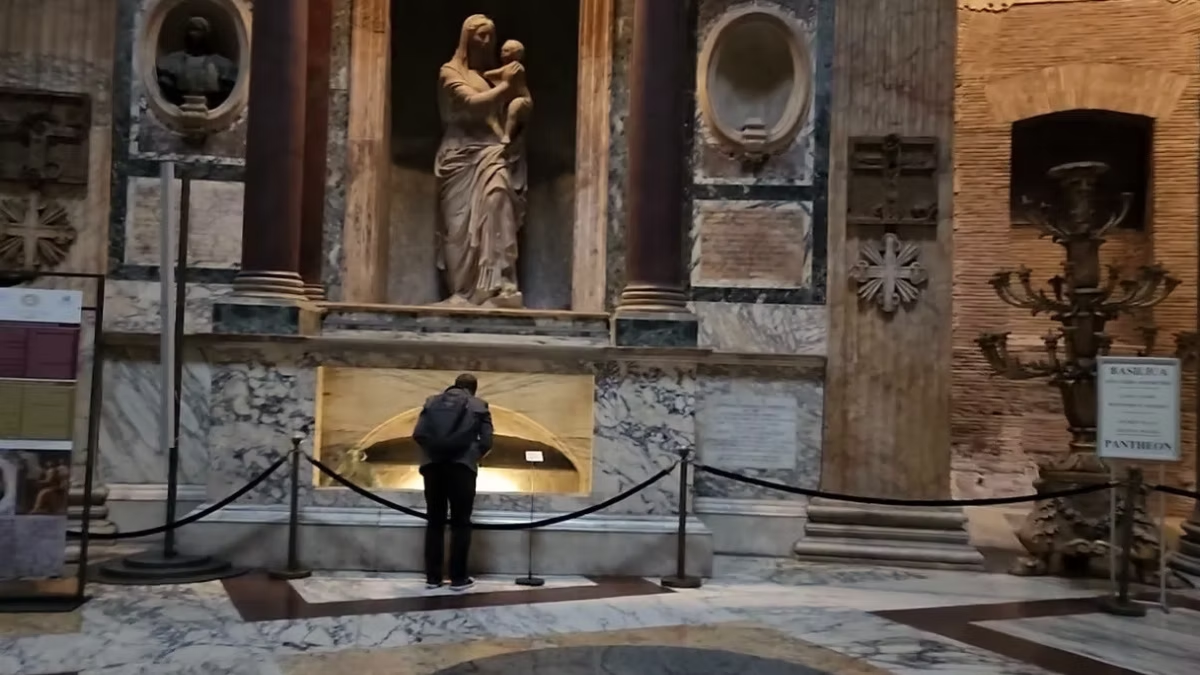
Raphael’s tomb is in the third niche on the left as you enter the Pantheon, counting clockwise. His stone sarcophagus was carved by his pupil Lorenzetto. Above it stands Lorenzetto’s marble statue of the Madonna del Sasso. The epitaph, written in Latin by Cardinal Pietro Bembo, reads: “Here lies Raphael, by whom Nature feared to be outdone while he lived, and when he died, feared that she herself would die.” Raphael died on his 37th birthday, 6 April 1520, and was buried in the Pantheon by his own prior arrangement.
Of all the things to find inside the Pantheon, Raphael’s tomb may be the most quietly moving. The dome is enormous, the geometry extraordinary, the ancient marble overwhelming in its completeness. But in the third niche on the left, behind a simple marble arch with a Latin inscription that has not changed in five hundred years, lies the greatest painter of the High Renaissance — placed here at his own request, in the building he admired above all others. This article tells the full story of how he came to be here.
Who Was Raphael?
Raphael Sanzio (1483–1520) was one of the three defining figures of the Italian High Renaissance, alongside Leonardo da Vinci and Michelangelo. He painted the Stanze della Segnatura in the Vatican (including the School of Athens), the Sistine Madonna, and dozens of altarpieces and portraits. In the final years of his life he was also working as an architect — appointed architect of St. Peter’s Basilica in 1514 — and was surveying Rome’s ancient monuments at the time of his death.
Raffaello Sanzio was born on 6 April 1483 in Urbino, a small ducal city in central Italy with a strong humanist intellectual tradition. His father, Giovanni Santi, was a court painter — giving Raphael access from childhood to both artistic training and the kind of educated patronage that shaped the most ambitious artistic careers of the period. He trained in Perugia under Pietro Perugino before moving to Florence around 1504, where he studied Leonardo’s technique and Michelangelo’s figure style. He arrived in Rome in 1508.
In Rome, Pope Julius II immediately commissioned him to fresco the private papal apartments in the Vatican — what are now called the Stanze di Raffaello. The School of Athens alone — a vast imaginary gathering of the philosophers of antiquity, with Plato and Aristotle at its centre — established Raphael as the peer of any artist alive. He followed it with the Liberation of St. Peter, the Parnassus, and the Disputation of the Holy Sacrament.
In 1514, following the death of Bramante, Raphael was appointed chief architect of St. Peter’s Basilica. In the last years of his life he was simultaneously finishing the Vatican Logge, designing the Villa Madama, working on large altarpieces, and leading a team to survey and document the ancient monuments of Rome. He wrote a letter to Pope Leo X proposing a systematic survey of ancient Rome’s topography — a project cut short by his death.
The Pantheon and Raphael’s Connection to Ancient Rome
Raphael’s survey of ancient Roman monuments gave him an intimate knowledge of the Pantheon. He measured its columns, mapped its proportions, and understood — as a practising architect — the extraordinary engineering achievement the building represented. The interior sphere, the graduated concrete dome, the relationship between the oculus and the building’s geometry: Raphael studied these not as a tourist but as a professional. His deep knowledge of the building intensified his admiration for it.
He purchased a niche in the Pantheon during his lifetime — a deliberate act requiring negotiation with the ecclesiastical authorities who managed the building. He wanted to be buried in the greatest surviving building from antiquity, having dedicated his career to understanding and being inspired by that world.
Raphael’s Death
Raphael died on Good Friday, 6 April 1520 — his 37th birthday. Contemporary accounts attribute his death to a violent fever. Giorgio Vasari, the great Renaissance biographer, claimed Raphael had concealed his illness from his doctor; others have suggested his demanding schedule had simply exhausted him. Whatever the cause, the shock was immediate and profound. At 37, he was at the peak of his powers and reputation.
His final major painting — the Transfiguration, now in the Vatican Pinacoteca — was still being completed at the time of his death and was carried alongside his coffin in the funeral procession as a testament to what had been lost. Raphael had not quite finished it; it was completed by his pupil Giulio Romano.
The Funeral
Pope Leo X — Raphael’s principal patron — reportedly wept when told of his death. The funeral was held two days later, on 8 April 1520. Four cardinals attended in full regalia. The Transfiguration was carried in procession through the streets of Rome. Contemporary accounts describe enormous crowds gathering to see the cortège pass. The body was received at the Pantheon, then called Santa Maria ad Martyres, and placed in the niche Raphael had purchased.
The scale of public mourning was unprecedented for an artist, reflecting both the extraordinary quality of his work and the personal warmth that Raphael apparently generated in everyone who knew him.
The Tomb
The sarcophagus was carved by his pupil Lorenzetto (Lorenzo Lotti, 1490–1541). It is a plain stone sarcophagus — deliberately unadorned, letting the setting and the inscription carry the weight of the memorial.
Above the sarcophagus stands Lorenzetto’s marble statue of the Madonna del Sasso (Madonna of the Rock) — so called because the Virgin rests one foot on a boulder. This sculpture was commissioned by Raphael himself before his death and completed by Lorenzetto afterwards. It is a significant Renaissance work in its own right.
The epitaph, carved in Latin on the tomb, was composed by Cardinal Pietro Bembo — the leading humanist scholar of the Renaissance. The Latin reads:
ILLE HIC EST RAPHAEL, TIMUIT QUO SOSPITE VINCI RERUM MAGNA PARENS ET MORIENTE MORI
A widely used English translation: “Here lies Raphael, by whom Nature herself feared to be outdone while he lived, and when he died, feared to die with him.”
Raphael’s Fiancée: Maria Bibbiena
To the right of Raphael’s sarcophagus is a smaller tomb bearing the name of Maria Bibbiena — his betrothed, niece of Cardinal Bernardo Dovizi da Bibbiena. Maria died in 1520, shortly before Raphael. The question of whether Raphael genuinely intended to marry her is complicated — he had been betrothed for several years but repeatedly delayed the wedding, and maintained a long relationship with Margherita Luti (“La Fornarina”), his primary model in his final years. Maria was buried in the niche Raphael had purchased; when Raphael died shortly afterward, he was buried beside her.
Where Exactly Is the Tomb?
Enter the Pantheon through the main bronze doors. Walk to the left. Count the niches as you move clockwise around the rotunda from the entrance. The third niche on the left — slightly to the left of the main altar’s axis — is Raphael’s. A bronze shield bearing his name is attached on the right side of the niche arch. The sarcophagus is at floor level; the Madonna del Sasso stands on a shelf above it; the Bembo epitaph is inscribed in marble above the arch.
Fresh flowers — often roses — are regularly placed at the tomb by the Accademia di San Luca, the institution that traces its lineage to the painters’ guild of Renaissance Rome.
The 1833 Tomb Inspection
Questions about whether Raphael’s sarcophagus actually contained his remains arose periodically over the centuries. In 1833, a formal inspection was authorised. Inside were found skeletal remains of a young man consistent with Raphael’s age and build at death. The inspection confirmed beyond reasonable doubt that the sarcophagus contains Raphael’s bones. The tomb was sealed again and has not been reopened since.
Frequently Asked Questions
Is Raphael definitely buried in the Pantheon?
Yes. The 1833 tomb inspection confirmed that the sarcophagus contains skeletal remains consistent with Raphael’s age and physical description at death. He has been continuously interred here since his burial in April 1520.
Why did Raphael want to be buried in the Pantheon?
He had studied the building closely as an architect and admired it above all ancient Roman structures. He purchased a burial niche during his lifetime — a deliberate, considered decision to be interred in the building he considered the greatest surviving monument of the ancient world.
Who wrote Raphael’s epitaph?
Cardinal Pietro Bembo, the leading humanist scholar of the Roman Renaissance.
How old was Raphael when he died?
37 — he died on his birthday, 6 April 1520.
What is the Madonna del Sasso?
The marble statue of the Virgin Mary above Raphael’s sarcophagus, carved by his pupil Lorenzetto to a design commissioned by Raphael before his death.
Where is Raphael’s most famous painting?
The School of Athens is in the Vatican Museums (Stanze di Raffaello). The Transfiguration, his final painting, is in the Vatican Pinacoteca.
