
Visiting the Pantheon with Kids & School Groups
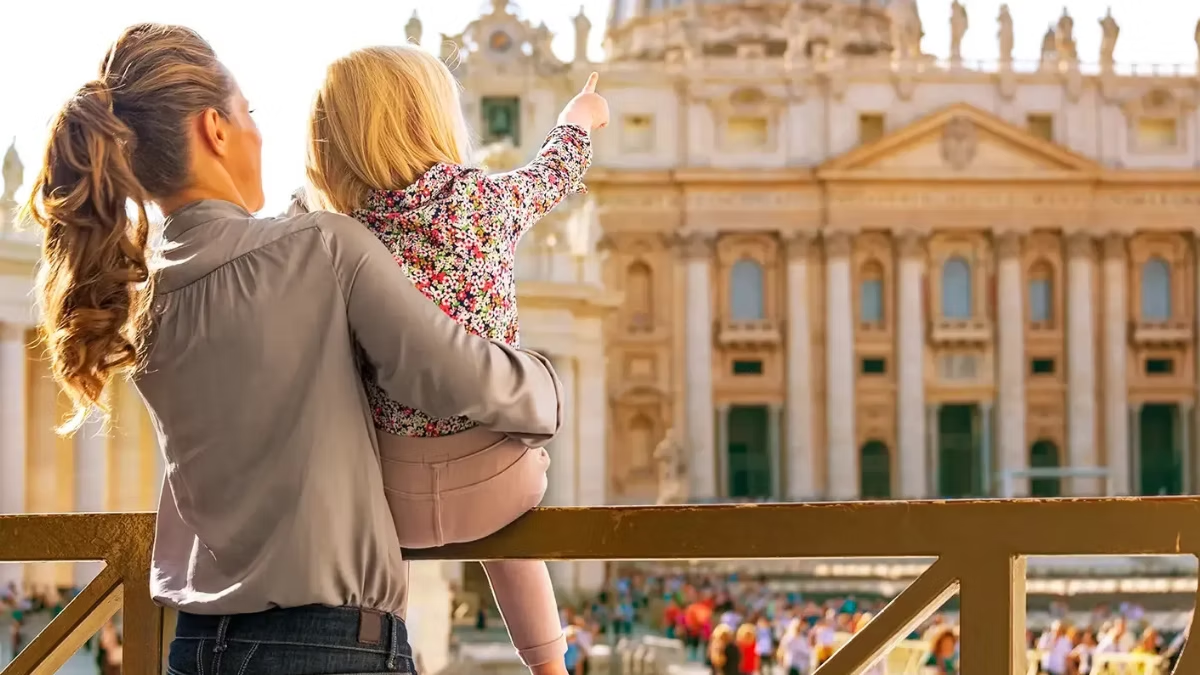
Children under 18 enter the Pantheon free of charge regardless of nationality, though a timed entry slot must still be reserved. School groups and parties of more than nine people cannot use the standard online booking system and must contact the Pantheon directly. The visit typically takes 20–30 minutes, making it well-suited to younger children’s attention spans. The oculus, the giant columns, and the rain drainage system are consistently the biggest hits with kids.
The Pantheon is one of the most family-friendly ancient monuments in Rome. Unlike the Colosseum or the Vatican Museums — which involve significant walking distances, large crowds, and extended time commitments — the Pantheon is a single-room building that can be fully explored in 20–30 minutes, is free for all children under 18, and contains several specific features that consistently captivate younger visitors. With a little preparation, it is an easy and rewarding stop for families of all ages.
Tickets for Children
Children under 18 enter the Pantheon free, regardless of nationality. A timed entry slot must still be booked in advance — free entry does not mean walk-in entry. For families with children, book one slot for the whole party through the official Musei Italiani portal or an authorised booking platform.
All visitors under 18 enter the Pantheon at no charge. This applies universally — there is no nationality or residency requirement. However, a timed entry slot is still required even for free-entry visitors. You cannot simply walk up with children and be admitted without a reservation.
When booking, include your children in the total number of visitors on the booking. Adults pay the standard €5 (or €3 for EU citizens aged 18–25); children are added at no additional cost. All members of the party — adults and children — enter during the same time slot.
For families visiting Rome, the Pantheon is one of the genuinely affordable inclusions in a sightseeing itinerary. With children entering free, a family of two adults and two children pays €10 total for standard entry — one of the lowest per-family costs of any major monument in the city.
What Children Love About the Pantheon
The Pantheon has several features that consistently capture children’s imagination and hold their attention in a way that many adult-oriented monuments do not:
The Oculus and the Open Sky
The oculus — the 8.9-metre circular opening at the top of the dome — is the first thing most children notice and the thing they talk about most afterwards. The idea that a building nearly 2,000 years old has a hole in its roof that lets in the sun, the clouds, and the rain is immediately intriguing. On sunny days, the beam of light that enters through the opening and moves across the walls as the sun progresses is genuinely extraordinary to watch. If it rains during your visit, the effect is even more dramatic — water falls through the opening onto the marble floor and drains through small holes in the centre, a detail that children find fascinating.
The Giant Columns
The sixteen granite columns of the portico are each 12 metres tall and 1.5 metres in diameter, quarried in Egypt and shipped to Rome. A local tradition among children is to try to hug the columns — it takes several people to encircle one. This tactile, scale-based experience tends to land well with younger children who might otherwise struggle to engage with architectural history in the abstract. (Do remind children not to touch or scratch the ancient surface — gentle proximity is the goal.)
The Dome
The dome’s sheer size — spanning 43.3 metres and still the world’s largest unreinforced concrete dome — is difficult to convey in photographs but immediately obvious in person. Many children spontaneously spin around to look at the coffered panels as they move toward the apex. Explaining that Roman engineers built this without modern machinery nearly two thousand years ago, and that it has never needed repairing, reliably produces a strong reaction.
Raphael’s Tomb
For older children and teenagers with some art history background, Raphael’s tomb in the third niche on the left is a natural point of interest. The inscription on the tomb — translated loosely as “Here lies Raphael, who feared that while he lived, nature herself would be outshone, and that when he died, she too would die” — is a good jumping-off point for discussion. For the full story, see our Raphael's Tomb guide.
The Rain Drainage System
A detail that consistently surprises both children and adults: the Pantheon’s marble floor is very slightly convex, and the 22 small drainage holes at its centre are the remains of a Roman hydraulic system that still functions after nearly two millennia. When it rains through the oculus, the water drains through these holes into an underground system below the piazza. This is a practical engineering story that children engage with directly.
Best Timing for a Family Visit
For families, the timing recommendations align closely with those for all visitors — but with additional practical considerations specific to children:
First thing in the morning (09:00–10:00 on weekdays): The least crowded window, giving children the best chance to move around freely and stand under the oculus without being buffeted by crowds. The oculus light at this hour is also especially dramatic.
Late afternoon on weekdays (after 15:00): Crowds thin from the midday peak. A visit at 15:30–16:00 on a weekday gives a relatively calm interior experience, and leaves time for a gelato stop in the piazza afterwards — a reliable family tradition.
Avoid 10:00–14:00 in peak season: With young children, the crowded midday interior — with up to 800 people moving around a single room — can be overwhelming and tiring. If your schedule allows, avoid this window in the summer months.
Weekdays over weekends: Saturday and Sunday visits are consistently more crowded. If you have flexibility, choose a weekday. Monday and Tuesday are the quietest days of the week.
For a full breakdown of crowd patterns by time of day and season, see our Best Time of Day to Visit the Pantheon guide.
Preparing Children for the Visit
A short conversation before arriving makes a significant difference to how children experience the Pantheon. Key points that tend to resonate with children of different ages:
For younger children (ages 5–8): Focus on the hole in the roof. Ask them to imagine a building where it rains inside. Tell them they are going to stand in a place where people have been standing for almost 2,000 years.
For older children (ages 8–12): Explain the engineering challenge — how do you build a round roof with no supports in the middle, using only concrete, without modern machinery? The answer (graduated concrete mix, lightweight pumice near the top, the oculus reducing weight at the apex) is genuinely fascinating at this age.
For teenagers: The Pantheon’s survival story works well — the only reason it still stands, while the Forum and Colosseum are ruins, is that it became a church in 609 AD. Every other major ancient Roman building was stripped for materials and left to decay. The Pantheon was protected by its religious function. It is a historical accident that the best-preserved building of the ancient world has survived — and a fascinating one.
Dress Code for Children
Children under approximately 12 are generally exempt from the Pantheon’s dress code requirements. For teenagers, the same rules apply as for adults — shoulders and knees should be covered. In practice, enforcement for children is relaxed, but it is good practice to dress teenagers modestly to avoid any complications at the entrance. For full dress code details, see our What to Expect at the Pantheon guide.
Strollers and Accessibility
The Pantheon’s entrance involves a single step and the interior floor is flat marble — navigable with a stroller under most conditions. However, at peak hours the interior can be very densely crowded, making manoeuvring a stroller difficult. For visits with very young children in a pram or pushchair, the early morning slot is strongly preferable to a midday visit.
School Groups: How Booking Works
School groups and parties of more than nine people cannot use the standard Musei Italiani online booking system. Groups must contact the Pantheon directly to arrange timed entry. Teachers leading school groups from EU countries are entitled to free entry. Students under 18 enter free regardless of nationality.
The standard online booking portal is designed for individual visitors and parties of up to nine people. For groups of ten or more — including school groups, educational tours, and organised visits — the process is different.
Booking: Contact the Pantheon’s management directly via the official Musei Italiani ticketing contact (dms-rm.pantheontickets@cultura.gov.it) to arrange group entry. Group visits require advance coordination and cannot be booked through the standard portal.
Pricing for school groups: – Students under 18: free entry – EU public school teachers accompanying groups: free entry (proof of employment and EU nationality required) – Other accompanying adults: standard adult pricing applies
What to bring: All group leaders should bring documentation confirming the group’s composition, including ages of students and, for teacher exemptions, proof of employment at a state school.
Timing: Group visits are typically scheduled outside the peak midday window. Early morning slots (09:00–10:00) or afternoon slots (after 15:00) are generally more appropriate for school groups, reducing the risk of the group being caught in the heaviest crowds.
After the Pantheon: Family-Friendly Nearby Stops
The Pantheon’s location in the historic centre means several excellent family-friendly destinations are within walking distance:
Piazza Navona (5 minutes): Rome’s most spectacular baroque square, with Bernini’s Fountain of the Four Rivers and open space for children to walk around. Also home to Il Sogno, a toy shop on the edge of the piazza that reliably enchants younger children. For more, see our Pantheon to Piazza Navona guide.
Gelato in Piazza della Rotonda: Several gelaterie surround the Pantheon piazza. Sant’Eustachio il Caffè (Via degli Orfani) and the Antica Salumeria in the piazza itself are local favourites. Giolitti (Via Uffici del Vicario), a few minutes’ walk away, is a Roman institution open daily from 07:00.
Largo di Torre Argentina (5 minutes south): The excavated ruins of four Republican-era temples, now also home to Rome’s famous cat sanctuary — one of the more unusual and charming stops in the city centre, consistently popular with animal-loving children.
Trevi Fountain (10 minutes): The coin-throwing tradition at the Trevi Fountain is a near-universal hit with children of all ages. See our Pantheon to Piazza Navona and Half-Day Itinerary guides for how to string these stops together.
Frequently Asked Questions
Is the Pantheon free for children?
Yes. All visitors under 18 enter free regardless of nationality. A timed entry slot must still be booked — free entry does not mean walk-in entry.
Do I need to book tickets for my children?
Yes. You must include children in your booking so the total party size is accounted for in your timed slot. Adults pay €5; children are added at no charge.
Is the Pantheon suitable for toddlers and very young children?
Yes, with some practical caveats. The visit is short (20–30 minutes), the interior is a single level with no stairs, and the dramatic dome and oculus tend to captivate even very young children. Avoid peak hours for the most comfortable experience with a stroller.
How do school groups book tickets?
Groups of more than nine people must contact the Pantheon directly via dms-rm.pantheontickets@cultura.gov.it rather than booking through the standard portal.
Are EU teachers exempt from paying?
Yes. EU public school teachers accompanying official school groups enter free upon presenting proof of employment and EU nationality.
How long should I plan for a visit with young children?
20–30 minutes is sufficient for most young children. With older children who want to look at everything in detail, 40–45 minutes is comfortable. Have a gelato plan ready for after — it makes an excellent reward and transition to the next stop.
